Why Choose Edge Lit Acrylic for Global Sourcing?
Edge Lit Acrylic offers a refined way to create bright, slim, and energy-conscious displays. Light enters through the acrylic edge and travels across a precisely engraved surface. This process creates even illumination from a compact LED system. It can support retail signs, menu boards, reception panels, and architectural displays. The result is clean, modern, and easier to ship than bulky illuminated structures.
Global sourcing requires more than comparing unit prices. Buyers should review acrylic thickness, optical clarity, engraving depth, LED color temperature, power requirements, and packaging strength. A reliable supplier can provide samples, production photos, inspection records, and clear tolerances. Small details matter. A poorly protected corner can damage an otherwise excellent panel during transport. Regional requirements also differ, so buyers should request suitable electrical documentation for the destination market. Independent testing may be appropriate for larger projects or public installations.
Experience teaches a less comfortable lesson: the cheapest quotation is rarely the complete cost. Tooling changes, rejected samples, freight delays, and inconsistent color can reduce the original savings. Edge Lit Acrylic also needs careful design; excessive brightness does not always improve readability. Some specifications may look ideal on paper but perform differently in a real showroom. That uncertainty deserves testing. A practical sourcing plan combines factory capability, transparent communication, sample approval, and documented quality checks. When these elements align, buyers gain a scalable lighting solution with strong visual impact and fewer avoidable surprises.
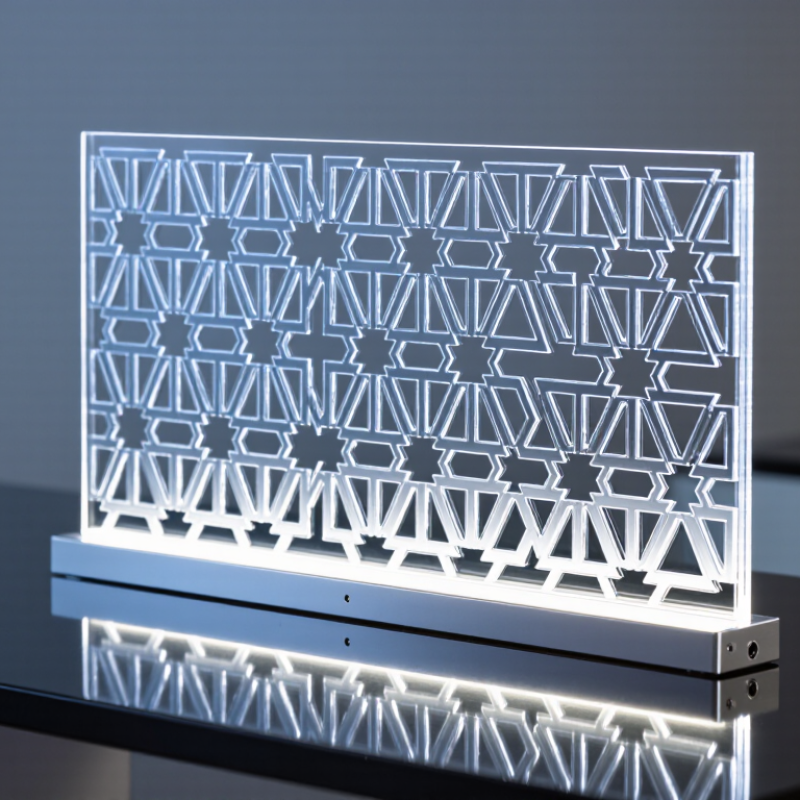
Edge-lit acrylic is a clear PMMA panel illuminated from its edges, rather than by a lamp behind it. LEDs send light into a polished edge, and the light travels through the sheet by internal reflection. Laser-etched dots or printed extraction patterns redirect it toward the viewer, creating a glowing face.
It sounds simple. But it isn’t. Pattern spacing, sheet thickness, and edge quality affect whether the center glows evenly or looks patchy.
For global sourcing, specify the panel dimensions, thickness, LED color temperature, and required brightness before comparing suppliers. Ask how each supplier controls extraction patterns and checks light uniformity. The U.S. Department of Energy’s Energy Saver guidance reports that LEDs use at least 75% less energy than incandescent bulbs and can last up to 25 times longer. Those figures compare light sources, not complete acrylic signs, so they are a component-level benchmark, not a performance guarantee.
This distinction is easy to miss.
Tips: Request a lit sample, not just a clear-sheet sample. Check for dark corners, visible hotspots, and color shifts after the panel warms up. Confirm packaging protects polished edges during shipping; a small chip can change the finished glow. Then document the sample’s settings for repeat orders.
Edge lit acrylic offers a practical balance of appearance, weight, and shipping efficiency. LEDs sit along the panel edge and guide light through engraved or laser-treated surfaces. This design creates slim signs, displays, and decorative panels with clean illumination. In my sourcing experience, thinner products often reduce packaging volume and lower the risk of cracked components during long-distance transport. They also need fewer raw materials than deep light boxes.
Global sourcing requires more than comparing unit prices. Edge lit acrylic can support consistent production when suppliers control acrylic thickness, LED spacing, brightness, and color temperature. A warm 3000K sample may appear very different from a cool 6500K sample. Small edge gaps can also create visible dark zones. The first sample is rarely perfect. I have seen attractive prototypes fail because connectors, power supplies, or protective films were overlooked. Requesting dimensional drawings, sample testing, inspection records, and electrical documentation improves reliability. Still, every batch deserves review.
Tips: Ask for a pre-production sample, confirm voltage requirements, and test illumination after transport simulation. Check corners, cable exits, surface scratches, and color consistency under normal room lighting. Leave room for improvement. A supplier with clear tolerances and honest corrective actions is usually more valuable than the lowest quotation.
Edge-lit acrylic works best when the sheet guides light evenly from its edges. For sourcing, ask for the acrylic grade, thickness tolerance, and intended indoor or outdoor use. Clear cast acrylic often suits illuminated signs, while surface texture and tint can change brightness. Request a sample with the actual LED configuration, not just a polished sheet. Small details matter.
Inspect edge finishing under steady light. Rough cuts, chips, or uneven polishing can create bright spots and dark bands. Ask how suppliers control laser engraving depth, panel dimensions, and LED spacing across production runs. A sample may look excellent, yet larger batches can reveal variation. Check several pieces, if possible.
Manufacturing capability is only part of the decision. Review inspection records, packaging methods, and the supplier’s process for handling rejected panels. Protective film and rigid corner guards help reduce scratches and cracked edges during shipping. Confirm that color, dimensions, and brightness are documented in the purchase specification. This step is easy to miss. It can prevent disputes later. Also consider how replacement panels will match the original batch; exact consistency is not always realistic, especially when materials come from different production lots.
Typical visible-light transmission for clear 3 mm sheet materials. Acrylic provides high optical clarity, low density, and reliable machinability for edge-lit signage and illuminated panels. Actual performance varies by grade, thickness, surface finish, and processing quality.
Clear acrylic typically reaches about 92% visible-light transmission, supporting efficient light distribution from LED edges while remaining lighter than glass. When sourcing globally, also evaluate sheet uniformity, laser or CNC cutting quality, edge polishing, dimensional tolerance, UV resistance, and protective packaging.
Global sourcing for edge-lit acrylic starts with a clear specification. State the panel dimensions, acrylic thickness, engraving depth, edge finish, and lighting requirements. Ask suppliers how they control light uniformity across the panel. A bright corner beside a dim center is easy to miss in product photos. Request a sample under the same lighting conditions planned for production. Small details matter.
Compare more than unit prices. Include tooling, minimum order quantities, packaging, freight, and replacement terms in your cost review. Ask for a production schedule with sample approval, manufacturing, and inspection dates. Then check whether the supplier can maintain those steps at your expected volume. A polished prototype does not guarantee consistent batches. It is worth asking for inspection records and photos of packed goods, though these do not replace independent checks when the order is significant.
Production capability should match the design, not just the catalog. Ask about laser engraving tolerances, edge polishing, LED placement, and how panels are protected from scratches. Request a small pilot run before committing to a large quantity. Compare the finished panels for brightness, engraving clarity, and color consistency. One weakness in this process: specifications can still leave room for interpretation. Keep a signed sample and written acceptance criteria, and revisit them if the design changes.
Edge-lit acrylic is useful when an international project needs bright visuals without a bulky lightbox. LEDs enter the acrylic edge and spread through a laser-etched or textured light guide. This structure supports retail signs, hotel directories, airport wayfinding, museum panels, and thin architectural features. It also reduces visual weight in narrow corridors.
Selection should begin with the application, not the catalogue image. Confirm the required luminance, viewing distance, panel thickness, color temperature, and color-rendering performance. A warm 3000K tone may suit hospitality spaces, while neutral 4000K often works better for offices and public signs. Check LED voltage, heat control, access for maintenance, and expected operating hours. Outdoor projects need suitable sealing, UV resistance, and verified ingress protection.
Details matter across borders. Request production samples at the final size, because small samples can hide uneven brightness near corners. Review dimensional tolerances, acrylic grade, diffuser performance, packaging strength, and replacement-part availability. Electrical documentation should match the destination market’s requirements. Ask for test reports, inspection records, and batch consistency data. A clear drawing should show cable exits and fixing points.
A sample can still mislead.
From project experience, shipping damage and color variation create more trouble than the acrylic itself. Some specifications are improved later, which is not ideal. Allow time for a pilot batch, independent inspection, and a practical installation review before approving full production.
It is a clear acrylic panel illuminated from its edges. LEDs send light into a polished edge, creating a glowing front surface.
Light travels through the sheet by internal reflection. Etched dots or printed patterns redirect light toward the viewer.
Pattern spacing, sheet thickness, and edge quality affect brightness. Poor control can create dark corners, hotspots, or patchy areas.
Confirm panel size, thickness, brightness, color temperature, viewing distance, and required color performance. Small details matter.
Warm 3000K lighting can suit hotels and hospitality areas. Neutral 4000K lighting often fits offices and public signs.
Request a fully lit sample at the final size. Check corners, hotspots, color shifts, and brightness after warming.
Outdoor panels need suitable sealing, UV resistance, and verified ingress protection. Confirm heat control and electrical compatibility too.
A small chip on a polished edge can change the light distribution. Strong packaging should protect edges during transport.
Keep the sample settings, drawings, cable exits, fixing points, tolerances, and inspection records. Repeat orders become easier to compare.
A pilot batch can reveal color variation, uneven brightness, installation problems, and packaging weaknesses before full production.
Edge Lit Acrylic is a lighting solution that uses LEDs positioned along the edge of a specially designed acrylic panel. Light travels through the material and is distributed across its surface, creating an even, slim, and visually appealing illumination effect. For global sourcing, it offers advantages such as lightweight construction, efficient energy use, flexible shapes, consistent brightness, and reduced packaging and shipping demands. These features make it suitable for signage, displays, interior decoration, architectural features, and custom lighting projects.
When evaluating Edge Lit Acrylic suppliers, buyers should review acrylic grade, optical performance, thickness options, LED quality, color consistency, heat management, fabrication accuracy, and quality-control procedures. It is also important to compare total costs, including tooling, sampling, production, packaging, shipping, and lead times. Supplier capacity, communication, customization support, testing standards, and reliable documentation should be considered alongside price. The best choice depends on the project’s size, brightness requirements, environment, installation method, expected service life, and compliance needs in the target market.

Xinliangdian