10 Best Sign Lights for Businesses in 2026

Time:2026-11-06 Author:Liam
0%

A sign can represent a business long before a customer reaches its door. At dusk, clear lighting helps people spot a storefront, read its name, and find the entrance. The right Sign Lights can also make a shop, restaurant, or office look welcoming without overwhelming the street. But choosing a fixture is not just about brightness.

This guide to the 10 best sign lights for businesses in 2026 looks at practical details that affect daily use. We consider light output, energy demands, weather resistance, installation, and maintenance. A sign beside a busy road may need even illumination across large lettering, while a small café may benefit from softer light that keeps its window inviting. Small details matter. A poorly aimed fixture can create glare, hide parts of a logo, or shine into nearby windows. Not every site has the same needs.

Product features can look impressive on a specification sheet, yet real performance depends on sign size, placement, local weather, and operating hours. That is worth remembering. No single light is perfect for every business, and the brightest option is not automatically the best. The selections ahead are intended to help owners compare common styles and trade-offs before buying. Check each product’s current specifications, mounting requirements, and warranty, since these can change. With a little planning, you can choose lighting that makes your sign easier to see and fits the character of your business.
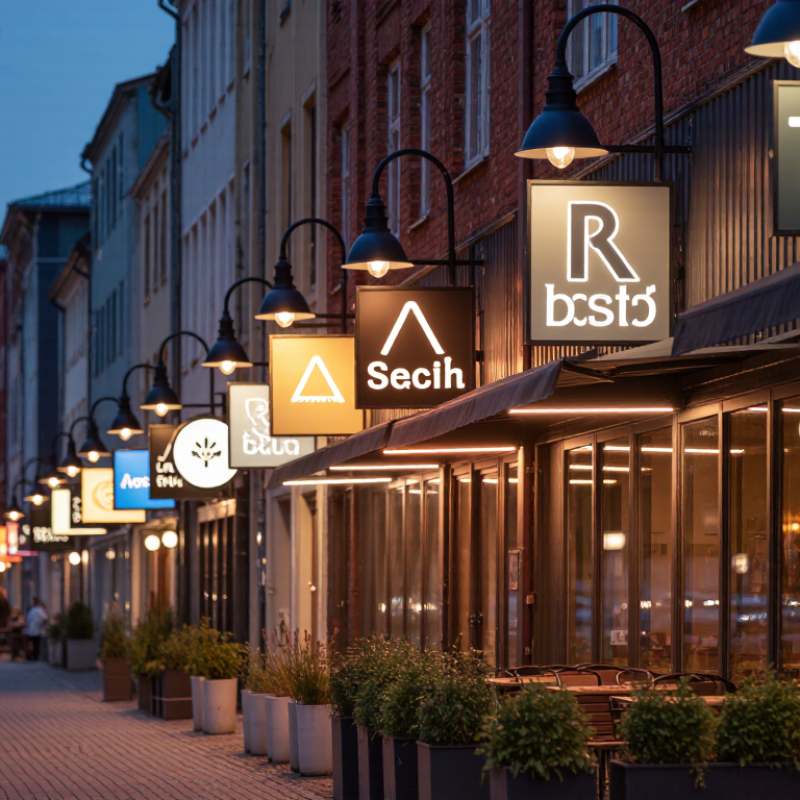
10 Best Sign Lights for Businesses in 2026

What Business Sign Lights Are and How They Improve Visibility

Business sign lights are fixtures that illuminate a company’s name, logo, or directional message. They may sit inside a sign cabinet, shine across raised letters, or wash light over a wall-mounted panel. The right setup makes lettering easier to notice after dusk and during overcast weather. It can also help visitors spot an entrance from a busy sidewalk or parking area.

Small details matter.

Brightness is only part of visibility. Even, well-aimed light helps keep letters readable, while glare can make them harder to see from the street. Before choosing a fixture, consider viewing distance, sign size, surrounding light, and whether the sign faces pedestrians or drivers.

A narrow beam may leave the sign’s edges dim; a stronger lamp may spill light onto nearby windows. That trade-off is easy to overlook.

Check the sign at night from the places customers actually approach, not just from directly underneath it. Weather, dirt, and aging components can also reduce output, so routine inspection helps maintain a clear appearance.

Light helps, but it cannot make crowded wording readable.

Key Factors for Evaluating Sign Lights in 2026

Choosing a sign light starts with the site, not the catalog. Check the sign’s size, viewing distance, mounting height, and direction of traffic. A compact storefront sign may need even illumination, while a roadside panel needs stronger output and careful glare control. Brightness is only part. Measure after dusk, when nearby streetlights and reflections become obvious. A sign that looks vivid indoors can disappear against a lit window.

Compare light distribution, color consistency, and energy use. Look for dark corners, hotspots, and visible gaps between illuminated sections. Ask how the fixture performs in rain, heat, dust, and vibration, then check its expected service life and replacement access. For outdoor installations, sealed housings and corrosion-resistant materials matter. So does safe, tidy wiring. Installation details are easy to overlook, and they can affect performance as much as the light itself.

Controls and maintenance deserve equal attention. Dimming can reduce glare after business hours, but overly complex controls may be ignored. Check whether components can be replaced without removing the whole sign. Compare total operating and maintenance costs, not just the purchase price. Where possible, review a sample at the actual site before committing. That step takes time, and it is not foolproof; changing weather and surrounding lights can still alter what customers see.

10 Best Sign Lights for Businesses in 2026

For businesses in 2026, the best sign light depends on the sign’s size, location, and viewing distance. Ten practical options include gooseneck lamps, linear LED bars, cabinet modules, edge-lit panels, backlit panels, adjustable spotlights, floodlights, halo-effect fixtures, solar-powered lights, and low-voltage strips. Gooseneck lamps suit storefront lettering, while even backlighting can make a large cabinet sign easier to read. Spotlights work for focused accents, but poor aiming can send glare toward drivers or neighboring windows. There is no universal winner.

Check light distribution before comparing brightness alone. A small sign may need only a few carefully aimed fixtures; a broad sign often needs consistent coverage. Review the fixture’s weather rating, mounting method, power needs, and access for maintenance. At dusk, inspect the sign from the sidewalk and across the street. Uneven patches can be surprisingly obvious. A clean installation can still look harsh, so adjust the angle and color tone before finalizing the layout.

Tips: Keep fixtures shielded where possible, clean lenses periodically, and test the sign after dark. Take a photo from the main approach; it can reveal glare or dim corners you missed in person. Don’t guess on wiring or structural mounting—ask a qualified installer when the setup is unclear.

10 Best Sign Lights for Businesses in 2026

Compare common sign-lighting types by application, installation, and practical considerations. Outdoor suitability depends on the specific fixture and installation.
Sign Light Type Best For Typical Installation Outdoor Consideration Main Advantage Consider Before Choosing
LED Sign Modules Channel letters, cabinet signs, and formed sign faces Modules are arranged inside the sign and connected to a compatible power supply Use components rated for the sign’s exposure and protect electrical connections from moisture Flexible placement helps distribute light across shaped or compartmentalized signs Layout, spacing, sign depth, and face material affect how evenly the sign appears illuminated
Rigid LED Light Bars Shallow cabinets, menu boards, and linear sign interiors Bars are mounted along the inside of the sign cabinet Check the fixture’s environmental rating if it will be exposed to weather Linear format can simplify installation in long, straight sign cabinets Confirm bar length, beam spread, and spacing suit the sign’s dimensions
LED Cabinet Retrofit Kits Existing internally lit cabinets being converted to LED Existing lighting is removed or bypassed as required, then LED components are installed Inspect the cabinet, wiring, and seals before upgrading an outdoor sign Can update an existing sign without replacing the full cabinet Compatibility and electrical work vary; follow the kit instructions and applicable codes
LED Strip or Tape Lighting Sign accents, shallow details, and concealed edge effects Adhesive-backed or channel-mounted strips are fitted to clean, suitable surfaces For exposed locations, choose a suitable weather-rated strip and protect its connections Can follow straight or gently curved design details Heat management, surface preparation, and even spacing matter; strips may not suit broad-area illumination
LED Floodlights Large outdoor signs, freestanding signs, and sign faces without internal lighting Fixtures are mounted externally and aimed at the sign Select a weather-rated fixture and mount it securely for local wind and site conditions Can illuminate large sign faces without opening the sign cabinet Aim and spacing should limit dark areas, glare, and unwanted light spill
Gooseneck LED Fixtures Wall-mounted signs, storefront lettering, and projecting signs Fixtures are mounted above the sign and directed downward Use fixtures and mounting hardware suitable for the wall and outdoor exposure Provides a distinctive downward-lit appearance and keeps lighting outside the sign face Fixture projection and spacing affect coverage; check for shadows and glare from the viewing area
Perimeter or Edge Lighting Sign outlines, architectural lettering, and decorative borders Lighting is installed around the sign’s edge or within a purpose-designed profile Outdoor systems need suitable seals, wiring, and weather protection Emphasizes a sign’s outline without necessarily lighting its entire face It is usually an accent treatment rather than a substitute for uniform face illumination
Solar-Powered Sign Lights Remote signs or sites where connecting to mains power is difficult A solar panel, charge controller, battery, and light are installed as a matched system Panel placement must account for sunlight, shading, seasonal conditions, and secure mounting Can avoid a direct grid connection at suitable locations Available runtime depends on sunlight, battery capacity, light output, and operating schedule
Backlit Panel LED Systems Translucent sign faces, information panels, and display graphics LEDs are positioned behind a translucent panel inside a light box For outdoor use, the panel enclosure and electrical components need appropriate protection Lights the sign face from behind for a clear, internally illuminated appearance Panel material, depth, and LED layout influence brightness and uniformity
RGB or RGBW LED Systems Decorative signs, event displays, and color-changing features LEDs are installed in or around the sign and connected to a compatible controller Match the outdoor rating of the lights, controller enclosure, and connections to the installation Allows adjustable colors and, with compatible controls, changing lighting effects Requires compatible control equipment; color effects may be less suitable where simple readability is the priority

How Sign Light Types Compare Across Business Needs

Choosing sign lights starts with the viewing distance, facade, and hours of operation. Internally lit LED cabinets suit roadside businesses because their message stays visible after dark. Halo-lit letters create softer edges on a storefront, while external gooseneck lamps add focused light to painted or dimensional signs. Neon-style LED lighting can bring color, but intricate shapes may be harder to repair. Bright, but not always better. Glare can wash out lettering, especially on glossy panels.

Energy and upkeep also separate the options. The U.S. Department of Energy’s Energy Saver guidance reports that LEDs use at least 75% less energy and last up to 25 times longer than incandescent lighting. Those figures compare LEDs with incandescent bulbs, not every sign-lighting system. Still, they help explain why LED modules are common for signs that run nightly. A small drawback: poorly placed LEDs can create bright spots instead of even illumination. Ask an installer to check the sign after sunset, not only in daylight.

Tips: Match the fixture to the sign surface. Use shielded external lights when nearby windows could catch glare. For a small café sign, warm, modest lighting may feel more welcoming than a high-output white beam. Compare the quoted wattage, access for servicing, and replacement costs—not just the purchase price. A neat installation can still be difficult to maintain.

How to Choose, Install, and Maintain Business Sign Lights

Choosing sign lights begins with the sign itself. A shallow cabinet, raised lettering, and a printed panel need different beam angles and mounting positions. Check viewing distance, nearby streetlights, and the sign’s surface before choosing brightness. The U.S. Department of Energy’s Energy Saver guidance says LEDs use at least 75% less energy and last up to 25 times longer than incandescent lighting. Those comparisons do not guarantee the same savings for every sign; drivers, controls, and operating hours matter. A lighting plan should account for them.

During installation, aim fixtures to illuminate the full sign without sending glare toward drivers or neighbors. Seal cable entries and use equipment rated for the sign’s outdoor exposure. Have a qualified electrician handle connections, and confirm that the mounting surface can support the fixtures. Test at dusk. Uneven brightness can be hard to spot in daylight, and a small shadow may obscure part of a letter.

Tips: Photograph the sign at night from the sidewalk and across the street. Keep those images as a baseline, then inspect monthly for flickering, water intrusion, loose mounts, or dim sections. Clean lenses with a soft cloth; abrasive pads can leave scratches. Replace failing components promptly, but review the cause first. A recurring failure may point to heat, moisture, or a poor connection—not simply an old lamp. Small details matter.

10 Best Sign Lights for Businesses in 2026: Comparing Light-Source Efficiency

Typical luminous efficacy ranges for common light sources used in sign lighting, measured in lumens per watt (lm/W). Higher values indicate more light output per unit of electricity.

LEDs generally offer high efficacy and are a practical starting point for illuminated signs. Actual performance depends on the fixture, driver, optics, and installation; compare complete products and check their specifications before choosing.

FAQS

What are business sign lights?

They illuminate a business name, raised letters, or directional message. Fixtures may sit inside a cabinet or shine across a wall panel.

How do sign lights improve visibility?

Even light helps people read signs after dusk or during overcast weather. It can also make an entrance easier to spot from a sidewalk or parking area.

What should I consider when choosing sign lights?

Check the sign’s size, surface, viewing distance, and nearby streetlights. A narrow beam may leave the edges dim.

Is brighter lighting always better?

No. Strong light can create glare or spill onto nearby windows. I used to think brightness solved everything; it doesn’t.

How should fixtures be aimed?

Aim them to light the full sign without shining toward drivers or neighbors. Test at dusk. Small shadows can hide parts of letters.

What matters during installation?

Use equipment suited to outdoor exposure, seal cable entries, and check that the mounting surface can support the fixtures. Have a qualified electrician handle electrical connections.

How can I check whether a sign is evenly lit?

Photograph it at night from the sidewalk and across the street. Keep those images for comparison. The view from directly underneath can be misleading.

How often should sign lights be inspected?

Inspect monthly for flickering, water intrusion, loose mounts, or dim sections. Clean lenses with a soft cloth; abrasive pads may scratch them.

What should I do if a light keeps failing?

Review possible causes, such as heat, moisture, or a poor connection. Replacing the lamp alone may not fix the problem. Small details matter.

Conclusion

This guide explains what Sign Lights are and how they help businesses make storefronts, building signs, and key messages easier to see. It outlines the main factors to consider when evaluating options in 2026, including brightness, energy use, durability, weather resistance, color quality, and ease of installation. The overview also compares ten practical sign-lighting choices, highlighting how different types can suit businesses with different locations, sign sizes, operating hours, and visibility goals.

Choosing the right solution means matching the light to the sign and its surroundings rather than focusing on brightness alone. The guide also covers planning placement, installing lights safely, and maintaining them through routine cleaning and checks. With thoughtful selection and upkeep, businesses can improve sign visibility, create a more welcoming appearance, and make effective use of lighting over time.


Liam

Liam

Liam is a dedicated marketing professional with a profound expertise in the industry, where he excels at highlighting the unique advantages of our core products. With a keen understanding of market trends and consumer needs, Liam frequently updates our company’s professional blog, providing......