Choosing the best Acrylic Faux Neon Sign from China requires more than comparing prices or glowing product photos. The decision involves optical quality, acrylic thickness, LED performance, wiring, packaging, and supplier reliability. The International Energy Agency reports that lighting represents roughly 15% of global electricity consumption, making efficient LED design commercially important. The U.S. Department of Energy also states that LED products generally use at least 75% less energy and last considerably longer than incandescent lighting. These figures explain why faux neon has become popular for cafés, bedrooms, retail counters, and event displays.
That answer varies. A strong Chinese supplier should provide clear specifications, including acrylic grade, light-strip density, color temperature, power consumption, and expected service life. Ask for close-up samples. Check whether the edges are polished, the glow is even, and dark spots appear around tight lettering. A reliable factory should also explain its testing process and offer traceable documentation for applicable safety and material requirements, such as RoHS, CE, or UL-related components. These marks should be verified, not simply printed on a quotation. Practical experience matters here: a sign can look excellent in a studio photograph yet reveal uneven illumination beside a window.
Market reports can guide the category, but they cannot replace inspection. I may overvalue visual brightness when reviewing suppliers; long-term heat management deserves equal attention. Packaging is another overlooked detail, especially for fragile acrylic faces and exposed wiring. The best Acrylic Faux Neon Sign from China is therefore not always the cheapest or brightest model. It is the product that balances appearance, energy use, customization, documentation, and dependable after-sales support. Details matter. An imperfect sample may still be useful if the supplier responds honestly and corrects measurable weaknesses.
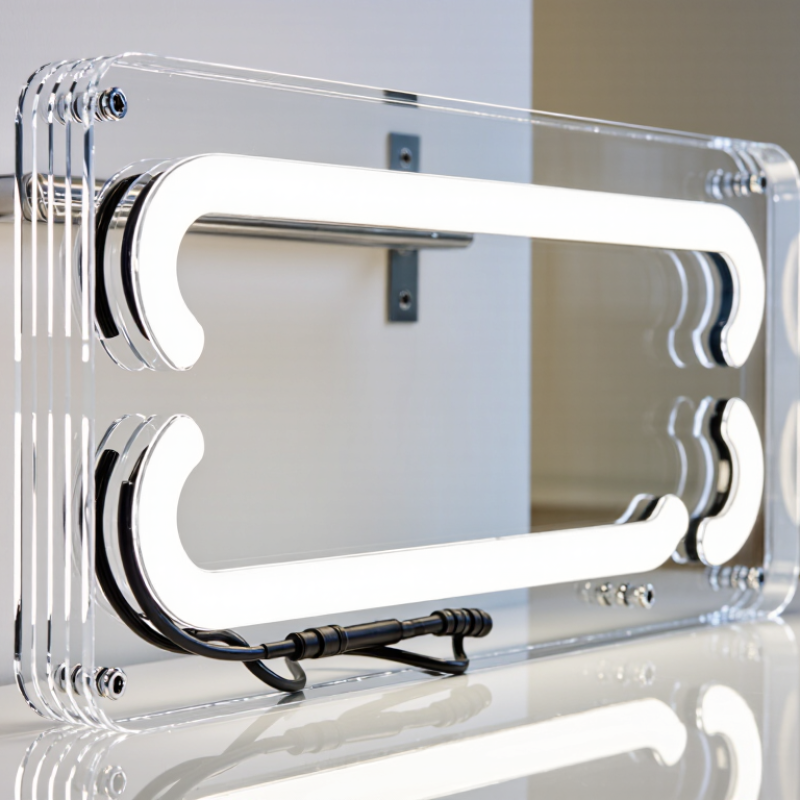
What Is the Best Acrylic Faux Neon Sign from China?
A high-quality acrylic faux neon sign begins with carefully selected materials. Clear acrylic should have an even surface, polished edges, and no cloudy marks. The panel must remain stable under normal indoor heat and light. A reliable sign also uses flexible LED lighting with consistent brightness across every letter. Dark corners and visible light spots usually indicate poor spacing or weak assembly.
In practical factory inspections, I check the backing, wiring, power connection, and heat control together. The LED strip should sit firmly inside a clean channel. Wires need secure joints and protective insulation. The power unit should match the sign’s voltage and load. Ask for a working sample, not only product photos. Run it for several hours and watch for flickering, unusual warmth, or color changes. Small details matter.
A strong supplier can provide material information, electrical test records, installation guidance, and clear packaging standards. Protective film should cover the acrylic before shipment. Corner protection is essential because one cracked edge can ruin an otherwise attractive sign. Custom designs also need accurate drawings and written color confirmation. No sign is perfect. A sample may reveal uneven spacing or a slightly weak glow. That is useful evidence, not a failure to hide. Careful review, honest communication, and repeat testing help identify the best acrylic faux neon sign from China.
| Quality Dimension | Recommended Benchmark | What to Check | Importance | Quality Result |
|---|---|---|---|---|
| Acrylic Sheet Quality | Optical-grade PMMA with a smooth, uniform surface and consistent color transmission | Check for bubbles, haze, edge cracks, uneven thickness, scratches, and visible color distortion under illumination. | High | Essential |
| Acrylic Thickness | Approximately 5–10 mm for most wall-mounted faux neon sign applications | Measure several points with a caliper. The selected thickness should match the sign size, mounting method, and required rigidity. | High | Recommended |
| LED Light Uniformity | Continuous-looking illumination without obvious dark spots, hot spots, or visible LED points | Inspect the sign from the front and from a 30–45 degree viewing angle. Test both dimmed and full brightness settings. | High | Essential |
| Color Consistency | Stable color output across the full sign, with a stated color temperature or color specification | Compare multiple sections of the sign and review a photographed or video sample under the same camera settings and ambient light. | High | Essential |
| LED Electrical Efficiency | Low-voltage LED system, commonly 12 V or 24 V DC, with a correctly sized power supply | Confirm the operating voltage, rated power, adapter capacity, cable size, and the presence of strain relief at cable exits. | High | Essential |
| Power Consumption | Clearly stated wattage based on the actual sign size and illumination area | Compare the measured input power with the specification. Allow suitable reserve capacity when selecting the power supply. | Medium | Verifiable |
| Heat Management | Low operating temperature with adequate ventilation around the LED and power-supply components | Operate the sign continuously and check for excessive heat, discoloration, softening, flickering, or adhesive failure. | High | Essential |
| Letter and Edge Finishing | Clean CNC-cut edges, smooth polishing, accurate contours, and no sharp burrs | Run a visual and fingertip inspection along the perimeter. Check that small letters and corners are not chipped or deformed. | High | Essential |
| Backing and Mounting Hardware | Rigid backing with secure screws, spacers, wall plugs, or a suitable hanging system | Confirm that mounting points are reinforced and that the hardware is appropriate for the sign weight and installation surface. | High | Recommended |
| Indoor or Outdoor Protection | Indoor models should be protected from moisture; outdoor models should specify an appropriate IP rating for the complete assembly | Review protection details for LED modules, connectors, cable exits, controller boxes, and the power supply rather than checking only the sign face. | High | Application-Based |
| Electrical Safety Documentation | Available test reports or conformity documents applicable to the destination market and product configuration | Verify that documents identify the actual model, input voltage, power supply, and relevant safety or electromagnetic-compatibility requirements. | High | Essential |
| Brightness and Dimming | Comfortable brightness for the intended environment, with optional dimming or remote control where required | Test readability in daylight and low light. Confirm that dimming does not cause visible flicker or unstable color output. | Medium | Recommended |
| Expected LED Service Life | A documented LED service-life estimate based on operating conditions, thermal design, and drive current | Treat lifetime figures as estimates. Ask for operating temperature limits, LED specifications, and the conditions used for the claim. | Medium | Verifiable |
| Quality Control Process | Documented inspection covering appearance, dimensions, wiring, brightness, voltage, and continuous operation | Request inspection records, production photos, a pre-shipment video, or a sample approval process before ordering in volume. | High | Recommended |
| Packaging and Transit Protection | Protective film, corner protection, impact-resistant inner packaging, and moisture-resistant outer packaging | Check whether the packaging prevents acrylic bending, face abrasion, cable damage, and movement during international transport. | Medium | Recommended |
| Customization Accuracy | Production dimensions, colors, cable locations, mounting holes, and artwork matching the approved drawing | Approve a dimensioned artwork proof and compare the delivered sign with the approved file before installation. | High | Essential |
| Warranty and Replacement Support | Written coverage for manufacturing defects, with defined procedures for replacement parts or repair | Review warranty duration, exclusions, response times, evidence requirements, and the availability of replacement power supplies or LED components. | Medium | Recommended |
| Total Cost of Ownership | Evaluation based on product quality, energy use, shipping protection, installation, maintenance, and after-sales support | Compare complete delivered cost rather than unit price alone, especially for customized, oversized, or outdoor signs. | High | Decision Factor |
Clear cast acrylic usually provides smooth edges and better stability. A thickness of three to five millimeters suits many indoor signs. Check for cloudy marks, scratches, and yellowing. Thicker is not always better.
The surface should appear even and clear. Polished edges should feel smooth, not brittle or rough. Protective film should cover the panel during shipping. One cracked corner can ruin the whole sign.
Look for consistent brightness across every letter. Dense LED spacing helps prevent dark corners and visible light dots. Test the sign at full brightness and while dimming. Flicker can hide during inspection.
The adapter must match the sign’s voltage and electrical load. Around twenty to thirty percent spare capacity is often practical. Check wire size, insulation, connectors, and grounding arrangements. Small solder joints may reveal rushed work.
Product photos cannot show every weakness. Run the sample for several hours or overnight. Watch for flickering, heat, noise, color changes, and uneven brightness. Disappointing results still provide useful evidence.
Compare acrylic thickness, LED spacing, wiring, adapters, edge finishing, and packaging. Review quotations line by line. Include tooling fees, minimum quantities, lead times, and replacement policies. The lowest price may hide limitations.
Ask for material details, electrical test records, installation guidance, and inspection photos. Written color confirmation helps prevent custom-order mistakes. Destination-market safety documentation may also be necessary. Fast replies alone prove little.
Protective film should cover the acrylic panel. Corners need firm protection against impact. Wiring and power parts should be secured inside the package. Packaging can look adequate and still fail; testing matters.
Choosing the best Acrylic Faux Neon Sign from China requires more than comparing prices. A high-quality sign should combine durable acrylic, bright and energy-efficient LED components, reliable wiring, and a stable power supply. Buyers should examine the sign’s brightness, color consistency, edge finishing, heat management, lifespan, and overall construction. Comparing manufacturers and suppliers is also important; evaluate their production experience, quality-control procedures, customization capabilities, communication, packaging, and after-sales support before placing an order.
Different applications may require personalized shapes, colors, sizes, mounting methods, and lighting effects. Buyers should also ask about safety testing, electrical protection, waterproof options, and applicable certifications for the intended market. The best choice depends on where and how the sign will be used, whether for indoor decoration, retail displays, events, hospitality spaces, or other commercial settings. By balancing design, performance, safety, customization, and supplier reliability, purchasers can select an Acrylic Faux Neon Sign that offers attractive appearance, dependable operation, and long-term value.

 Xinliangdian